Winter Nights (Vetrnætr)
Group show with Miriam Hansen, Simon Daniel Tegnander Wenzel, Úna Hamilton Helle, Marthe Andersen & Viktor Pedersen. Curated by Eleni Riga.
BO: Billedkunstnerne i Oslo
25 Sep - 2 Nov 2025
Extract from the essay by Eleni Riga:
Winter Nights is a group exhibition that reclaims the premises of the ancient turn-of-season rite from which it takes its name. It explores the ritual’s deep entwinement with nature and cyclical time, while considering its potential as a framework for reflecting on climate change and ecological grief.
In pre-Christian Scandinavia, Winter Nights (Vetrnætr) was a three-day festival marking the transition from summer to winter, featuring feasting and offerings to ancestors and spirits. Reflecting on Nordic animism and historian Rune Hjarnø’s writings, describing it as a means of recognizing animals, plants, rocks, waters, and spirits as “persons”, the exhibition seeks to re-establish kinship with the more-than-human world. Looking to traditions bearing this approach can offer us tools for re-entering a responsible, attentive relationship with the world.
The participating artists respond to this invitation through works that address seasonal change, power, history, magic, sleep, death, and rebirth, drawing on embodied experience, daily practices, family and land ties, as well as political concerns.
A guiding principle for the exhibition is the scotopic approach. From the Greek “skotos” (darkness), scotopic vision describes the eye’s adaptation to dim light. Here, it serves as a metaphor for ecological attentiveness: in darkness, we notice the fragile, hidden, or feared. Some works are presented in low light, inviting visitors to slow down, breathe, smell, listen while others invite us to embrace our inner darkness.
By foregrounding “Vetrnætr” as the central theme, the exhibition period coincides with the seasonal change it marks and becomes an invitation to reconnect with cyclical time, embrace rest, explore the unknown, and honor both nature and ancestral spirits. Through this, we might rekindle a sense of connection to the natural world and to one another, drawing on animist beliefs that recognize consciousness in all things.
Coming from a heliotropic society shaped by pagan traditions, I have witnessed how summer longing has escalated into overtourism, environmental devastation, water scarcity, megafires and climate injustice. By turning toward winter and darkness, I reconsider my attachment to land and seek, through ritual and myth, the courage to face what lies ahead.
Room 1
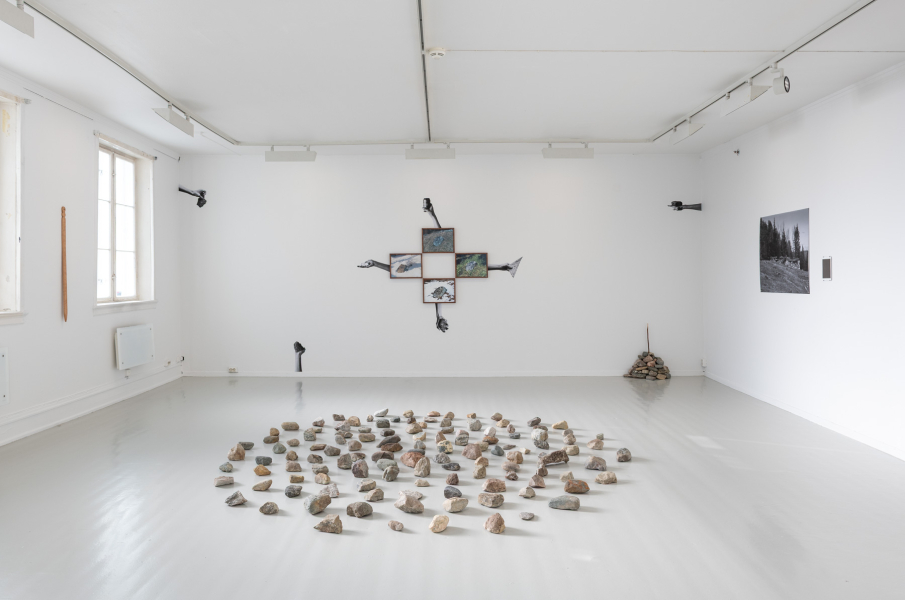
Úna Hamilton Helle presents a wall-mounted assemblage that brings together photographs, cut-outs, photocopies, the traditional Norwegian agricultural calendar primstav, alongside sculptural interventions with small stones and carved wooden sticks. Her installation unfolds as a layered, collage-like constellation, responsive to the space and attentive to the relations between objects, images and visitors.
The work is part of her ongoing project Tunsteinen (The Yard Stone), which develops from a sustained engagement with the «imaginary subterranean», as some stones were thought to be portals or homes for the land spirits that lived underground. Here, Helle asks how art can restore reciprocal, sensorial connections with the land, ones that resist extraction and instead cultivate intimacy. To this point, I would quote Susan Sontag: «The earliest experience of art must have been that it was incantatory, magical; art was an instrument of ritual.»
Human presence is suggested through gestures rather than figures: open hands offering lefse (traditional pastry), beer, or, more playfully, marshmallows, or else holding stones in a process of becoming acquainted with them. In these moments, stones emerge as active participants in the narrative, echoing Nordic animist traditions in which trees, waters and rocks are recognized as persons. The offerings, both customary and improvised, extend ancient practices into the present with a spirit of attentiveness and humility. They resist ideals of purity or perfection, instead proposing ritual as a way of fostering connection and attunement.
Helle has chosen the yard stone for its profound intimacy with place. Situated within the family’s farmstead, the stone is both marker and witness of continuity. Her inquiry begins with elemental questions: how does one enter into relation with a neighbor that is a stone—an entity so radically other, with whom no common language is shared? Over time, she has cultivated practices of attention, allowing the stone’s presence to shape the encounter. This ongoing dialogue has taken form across diverse media and is underpinned by an extended engagement with the cultural histories and ritual traditions through which stones have long been inscribed with meaning.
A central element in the installation is the primstav that will be turned on October 14 to mark the shift from summer to winter. As Helle notes: «Physically turning the calendar every six months made for a cyclical handling of time. A concept mirrored in the continuous re-experiencing of seasonally specific events and natural phenomena.» Such repetition imbues action with sacred meaning, as Catherine Bell observes, providing a structure through which people engage with both time and environment. In Helle’s version, the calendar incorporates not only seasonal markers but also contemporary observances such as Earth Day, World Animal Day, Pride folding present-day solidarities into older cycles. By marking time, we also make time: pausing to acknowledge, connect and participate in larger cycles of life. Helle’s assemblage ultimately functions as both offering and invitation—an attunement to land, spirits and the healing dimensions of ritual.
Úna Hamilton Helle’s work has been supported by the European Research Council (ERC) under the European Union’s Horizon 2020 research and innovation programme (Grant agreement No. 863944 THINK DEEP).
The works pictured are:
De jordfaste / The earthbound, stones (asked, foraged and laid in contact with the yard stone)
Tunsteinen (Vår/Sommer/Høst/Vinter) / The Yard Stone (Spring/Summer/Autumn/Winter), c-type and inkjet photos, varnished walnut frames, wallpaper paste
Primstav / Calendar stick, linden, wax
Verp, stones, carved branch
Norsk sætertradisjon / Norwegian pasture traditions, inkjet print, looped video
All 2025. Photos by Thomas Tveter.